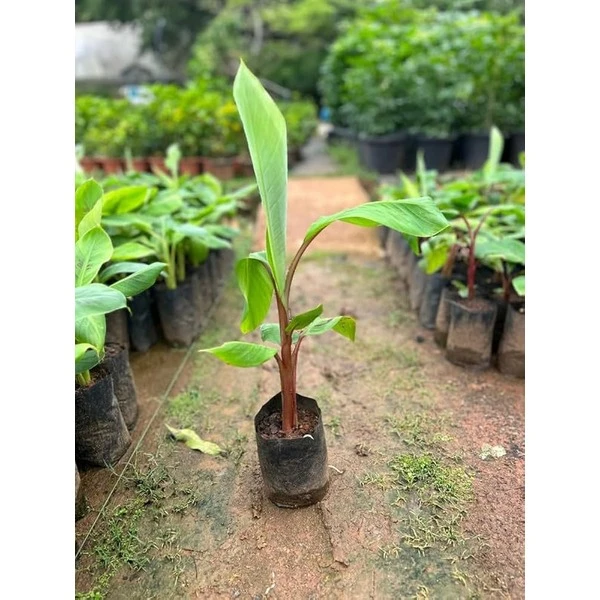
The banana plant is a large, herbaceous perennial that resembles a tree, but is actually a very large herb. It has a pseudostem, a false trunk formed by tightly packed leaf sheaths, which can grow up to 8 meters tall. The banana plant produces a single bunch of bananas per pseudostem, after which the pseudostem dies and is replaced.
Here's a more detailed description:
Pseudostem: The "trunk" of the banana plant is not a true stem, but a pseudostem formed from the base of the leaves. These leaf sheaths pack together tightly, creating a cylindrical structure that supports the plant.
Leaves: The leaves are large and spirally arranged, growing from the pseudostem. They can be up to 9 feet long and 2 feet wide. The leaves are composed of a sheath, a petiole (stalk), and a blade.
Flower: A large flower spike, carrying numerous yellowish flowers, emerges at the top of the pseudostem. The flowers are protected by large purple-red bracts.
Fruits: The banana plant produces bunches of bananas, with each bunch consisting of multiple hands (clusters) of individual fruits. The fruits are elongated and curved, with a thick skin that turns yellow or red as they ripen.
Underground System: The banana plant has an underground stem called a rhizome, which acts like a root system. The rhizome sends up new shoots (suckers) that can develop into new banana plants.
Other Characteristics:
Banana plants are monocotyledonous, meaning they have a single seed leaf.
They are herbaceous, meaning they have no woody stem.
After fruiting, the pseudostem dies down to the ground, and the plant is replaced by suckers from the rhizome.

No review given yet!
 Fast Delivery all across the country
 Safe Payment
 100% Organic Products
 100% Authentic Products












You need to Sign in to view this feature

This address will be removed from this list
 english